Summary and Reflection on Social Networking

To participate in IEMS5720 social networking is a great pleasure for me. Before I took apart in
this course, I used to think that social networking is more like reading story or report instead of
understanding theory and programming. However, Ms. Rosanna gives us a comprehensive introduction
to the concept, analysis and application of social networking which I never thought of. What’s more,
through several times of doing assignments, I have benefited a lot from this course.

Firstly, I understand what social media analytics is by acquiring relevant information in the
Internet. According to IEEE’s relevant definition, social media analytics is about making and assessing
information framework or tool to extract hidden key information from a large amount of
semi-structured and unstructured data collected in social media services in order to develop meaningful
and significant decision making (IEEE Intelligent Systems,2010). Apart from that, this process is
normally driven by the exact targets and requirements from desired practice. One feature that resembles
social media is that they both involve humanities and technologies. However, the other that doesn’t is
that social media analytics focuses more on “analysis” component such as natural language processing,
sentiment analysis & opinion mining algorithms, social network analysis and recommendation and
ranking.

Secondly, by finishing the two programming assignments, I think I learned a lot from this course.
The first programming assignment is sentiment analysis of comments on my blog, which belongs to
natural language processing category, and the other one encourages us to create a directed graph which
is able to represent the sociomatrix in order to understand and implement concepts such as density,
centrality and degrees etc. in the form of programming. By these two programming assignments, I have
learned basic concepts and mastered programming skills of social network comment analysis.

The last but not the least, it’s enjoyable and challenging to team up with other classmates to finish
the SDG 3 health and well-being. I used to think official data is more important than data from social
media platform since it can guarantee data’s accuracy. Nevertheless, through that process , I gradually
find data from social media more real-time and plentiful and can make a real difference if you
implement them properly.

Generally, taking part in this course is like a grand tour. I hope that one day I can implement those
techniques from this course into my work to help people to solve problems and make the world better.

References
1.D. Zeng, H. Chen, R. Lusch, and S.-H. Li. “Social Media Analytics and Intelligence”, IEEE
Intelligent Systems, vol. 25, no. 6, 13-16, 2010.

Blog post3: Can SMA help to realize SDG 1?

Background

As already illustrated in the last two blog posts, social media analytics is about making and assessing information framework or tool to extract hidden key information from a large amount of semi-structured and unstructured data collected in social media services in order to develop meaningful and significant decision making (IEEE Intelligent Systems,2010) and one of UN’s SDG1 targets is to eradicate extreme poverty for all people everywhere, currently measured as people living on less than $1.25 a day by 2030(UN SDG1 target 1.1). So in this blog post, I am going to combine the two topics together and try to illustrate why SMA matters in no poverty campaign, how SMA is applied to help realize “End poverty and all its forms” goal and what relationships need to get handled well.

Why SMA Matters?

As illustrated in the last blog, poverty standard can be varied and its causes can also be significantly different in different regions. On account of that, it is necessary to apply data technology in the work of poverty eradication. Combining with the actual situation of poor areas, finding out the relevant factors of poverty from social media can effectively help people in poor areas get rid of poverty and get a good development. Just take China for example, in Sichuan province, government with social media giant, sina weibo, collects data from people’s post in poor area to clearly identify what factors play negative roles in people’s way to better life. What’s more, compared with traditional data collecting method which includes making and passing archives in paper, SMA can be more effective and accurate and avoid such phenomena that finance aid is put onto wrong people’s hands or corruption happens.

How SMA Is Applied?

Before using SMA technique, establishing electronic archives is priority. Just take China for example, department ask people in poor area to upload their related information about annual income, housing conditions, physical health conditions, children education conditions and so on to wechat platform, which is a social media software issued by Tencent company. And then, using SMA technique to collect and analyze the uploaded data in order to identify the real poor family. Based on previous procedures, after information review, the accuracy and effectiveness of poverty alleviation will be improved by establishing a file in the database and modifying the changed data in time. Apart from the SMA’s identifying function, it can also be implemented to supervise whether the poverty alleviation resources are used into the real poor family instead of corrupted officials and to check that the “no poverty” campaign is put into reality. Just imagine, if the campaign goes wrong, people will upload their true status of their lives in the form of texts, pictures or video to the social media platform so that departments, individuals and even UN organizations will get the true information and know that something is wrong with related policy or methods and respond quickly towards it.

What Relationships Need To Get Handled Well?

Three relationships need to be dealt with in order to achieve accurate poverty alleviation by using SMA.

Data opening and security. The database has the characteristics of open sharing. In the acquisition and use of poverty alleviation data, it brings certain security risks to households and poor households involving personal privacy information and government related confidential information, which requires the use of governance methods to ensure that this part of data is not lost and abused in the open sharing of data.

The popularization and improvement of data technology. SMA brings convenience to poverty alleviation work, but at the same time, it puts forward higher requirements for operation technology. On the one hand, it is necessary to increase the technical training for poverty alleviation workers so that they can master the application methods of SMA; on the other hand, it is necessary to build a professional talent team to provide excellent technical support for data development and application.

Online and offline evaluation. It is important to judge the actual effect of poverty alleviation, but frequent assessment will distort the rural work. This requires using SMA instead of traditional methods for assessment and evaluation. For the evaluation indexes such as the accuracy rate of identification and withdrawal of the poor and the satisfaction of the working people, it is difficult to be accurate only by relying on SMA evaluation, and only by combining with the reality investigation and verification of the third party can accurate evaluation be achieved.

References

  1. UN. “The Sustainable Development Goal1–End poverty in all its forms everywhere”. In: https://www.un.org/sustainabledevelopment/poverty/
  2. D. Zeng, H. Chen, R. Lusch, and S.-H. Li. “Social Media Analytics and Intelligence”, IEEE Intelligent Systems, vol. 25, no. 6, 13-16, 2010.
  3. Alice (2016) how to perform a social media analysis – in 5 steps.
  4. Sun. “Using big data to achieve “precision” in poverty alleviation”. In: http://bigdata.idcquan.com/dsjjs/167899.shtml
  5. Luo. “Application of big data technology in targeted poverty alleviation”. In: http://www.jjykj.com/view.asp?nid=6769

Blog Post2: No Poverty

Poverty is actually beyond ordinary people’s imagination. Even in 21 century, there are many people living in poverty. According to UN’s report, more than 1/10 of the total population still live in severe poverty and has been struggling to fulfil the many basic needs. What’s more over, in 2018, 8% of the laborers were still very poor. Poverty has been laying too much burden and misery on the shoulder of those people for many years. In this case, UN has regarded ending poverty in all its forms everywhere as No.1 sustainable development goal and set targets to achieve by 2030.

NO.1 SDG no poverty

In this blog post, I will discuss about several issues related to this UN goal.

Firstly, by 2030, eradicate extreme poverty for all people everywhere, currently measured as people living on less than $1.25 a day (UN sustainable development goal 1 target1.1). This target has shown the overview intension from the highest level and quantified the poverty standard which is living on less than $1.25 a day. However, setting the poverty standard as $1.25 is over-simplified and ideal. In different places, people need different minimal cost to live on. For example, $1.25 a day is definitely not enough for people living in USA but it may be adequate for those living in African continent. So, in this case, setting different poverty standard by different countries is more reasonable. For example, trying to link the quantified poverty standard with this country’s GDP locally may be a good choice.

Secondly, by 2030, reduce at least by half the proportion of men, women and children of all ages living in poverty in all its dimensions according to national definitions (UN sustainable development goal 1 target1.2). I agree with this target plan. According to UN’s related introduction, poverty has many dimensions. So, defining those dimensions is too complicated to realize. However, we can separate those dimensions to national definitions locally and this process makes No Poverty Program more practical and easier to accomplish. We can stay optimistic towards it. However, reducing by half the proportion worldwide is never easy to get done. Nowadays, many countries still suffer from warfare and natural disasters. We need more practical plans, financial aid and material support worldwide to realize this target.

Lastly, we can still stay optimistic, according to economist Jeffrey Sachs. He calculated that the total cost would be around $175 billion per year to end poverty and all its forms in 20 years. This represents less than one percent of the combined income of the richest countries in the world. Generally speaking, UN’s goal has pointed out nearly all the forms of poverty everywhere. But as the old saying goes “easily said, hardly done”. We need to unite all power and resources to end poverty. From individual level, dynamic engagement in policymaking process is able to affect a lot in addressing poverty. From governmental level, government can help create more enabling environment to generate productive employment and job opportunities for the poor. And for private companies, it has a significant part to play in deciding if the growth it triggers is inclusive and thus contributes to poverty reduction. Giant companies can provide more and more economic opportunities for those poor people.

References

  1. UN. “The Sustainable Development Goal1–End poverty in all its forms everywhere”. In: https://www.un.org/sustainabledevelopment/poverty/

Blog post 1: What is social media analytics?

With the rapid development of Internet and other advanced information technology, the form of media has been changed. Twitter, amazon online shopping, and even wikipedia have gradually taken the most place of tradition media in people’s daily life. On account of prosperous growth of social media, more and more scientists and engineers choose focus on this field, which, on the other hand, leads to social media analytics.

According to IEEE’s relevant definition, social media analytics is about making and assessing information framework or tool to extract hidden key information from a large amount of semi-structured and unstructured data collected in social media services in order to develop meaningful and significant decision making (IEEE Intelligent Systems,2010). Apart from that, this process is normally driven by the exact targets and requirements from desired practice. One feature that resembles social media is that they both involve humanities and technologies. However, the other that doesn’t is that social media analytics focuses more on “analysis” component such as natural language processing, sentiment analysis & opinion mining algorithms, social network analysis and recommendation and ranking.

Generally speaking, the social media analytics process (Alice, 2016) contains (1). listen with a purpose. Before starting this procedure, it is significant to assume that the aim within receiving from social media.(2) gathering data. gathering data is a hard experience which often consumes lots of time and is easily influenced by human error. Using software may be a good way out. (3) organizing data. The following procedure is to organize the data into relevant categories. (4). interpreting data. Many interactions could not be kept out for interpretation as it is often from a larger data trail or conversation in which the wider context needs to be understood. (5) action the data. Now that the data has been gathered and interpreted, it will be measured against the original corporation aims, with considering to be paid to how consequences connect to other departments within the business.

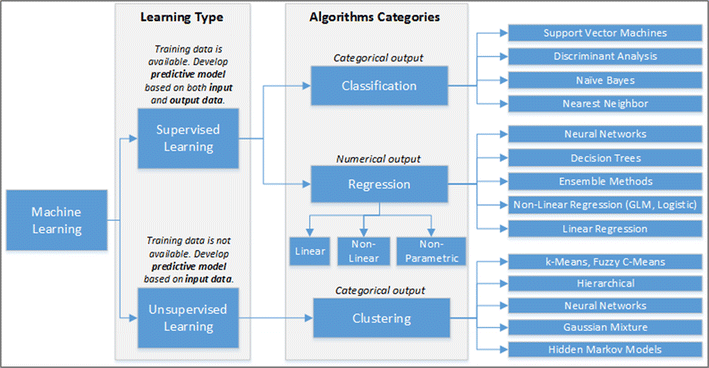
And the techniques of it are (1) Computational science techniques. Automated sentiment analysis of digital texts uses elements from machine learning (Turney 2002).


Fig.1. Machine Learning Overview

(2) Sentiment analysis. Sentiment is about mining attitudes, emotions, feelings—it is subjective impressions rather than facts. Generally speaking, sentiment analysis aims to determine the attitude expressed by the text writer or speaker with respect to the topic or the overall contextual polarity of a document (Mejova 2009).

References

1.D. Zeng, H. Chen, R. Lusch, and S.-H. Li. “Social Media Analytics and Intelligence”, IEEE Intelligent Systems, vol. 25, no. 6, 13-16, 2010.

2.Alice (2016) how to perform a social media analysis – in 5 steps.

3.Turney PD (2002) Thumbs up or thumbs down? Semantic orientation applied to unsupervised classification of reviews. In: Proceedings of the 40th Annual Meeting on Association for Computational Linguistics pp. 417–424.

4.Mejova Y (2009) Sentiment analysis: an overview, pp 1-34. Accessed 4 Nov 2013.


通过 WordPress.com 设计一个这样的站点
从这里开始